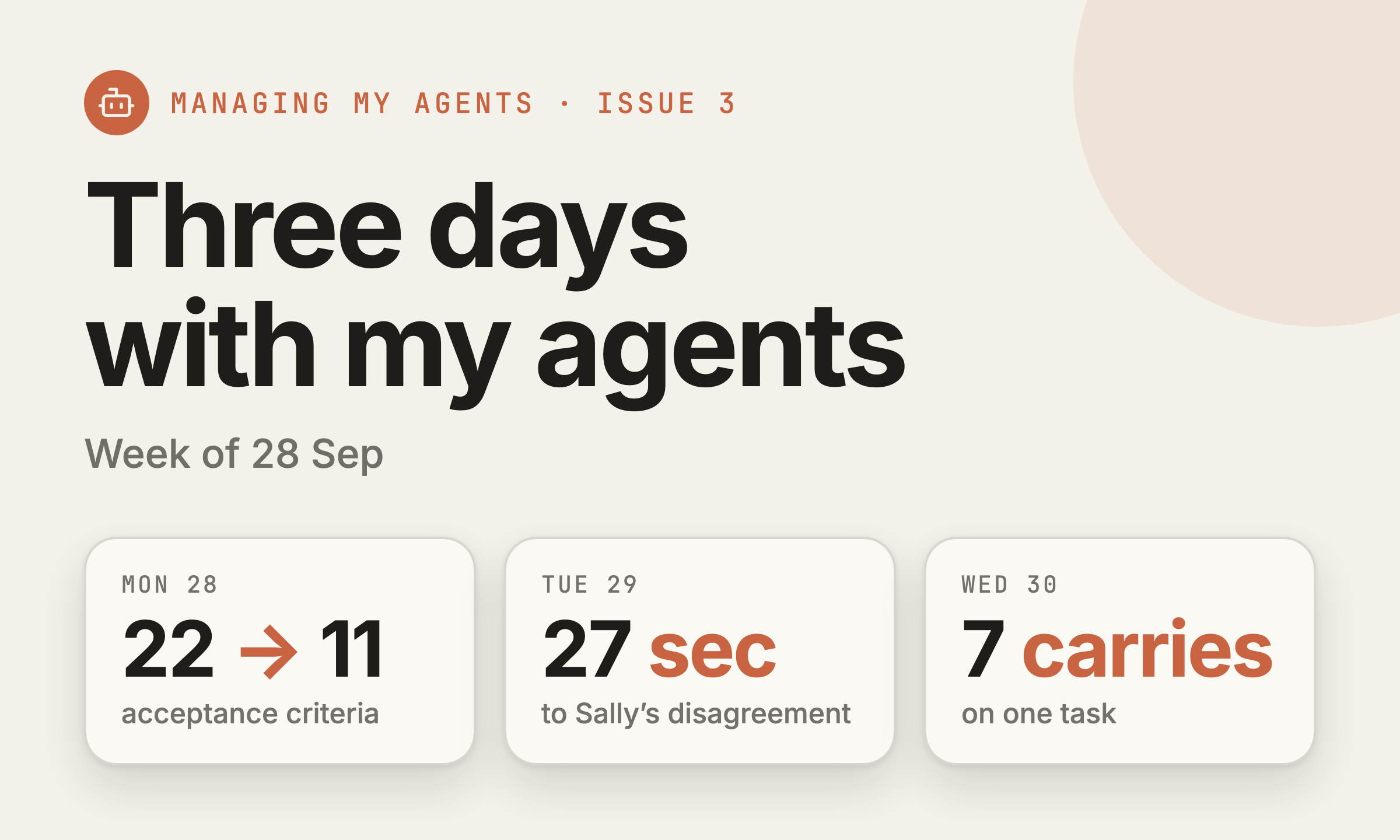
Three days from the week of 28 Sep, with Sally, the orchestrator agent that runs the other agents in my setup.
Sally had recommended splitting a spec into four stories.
And I said no, one story.
So she wrote one, ran her own checks on it, and told me it was the first time I’d let a spec stay one story without a fight.
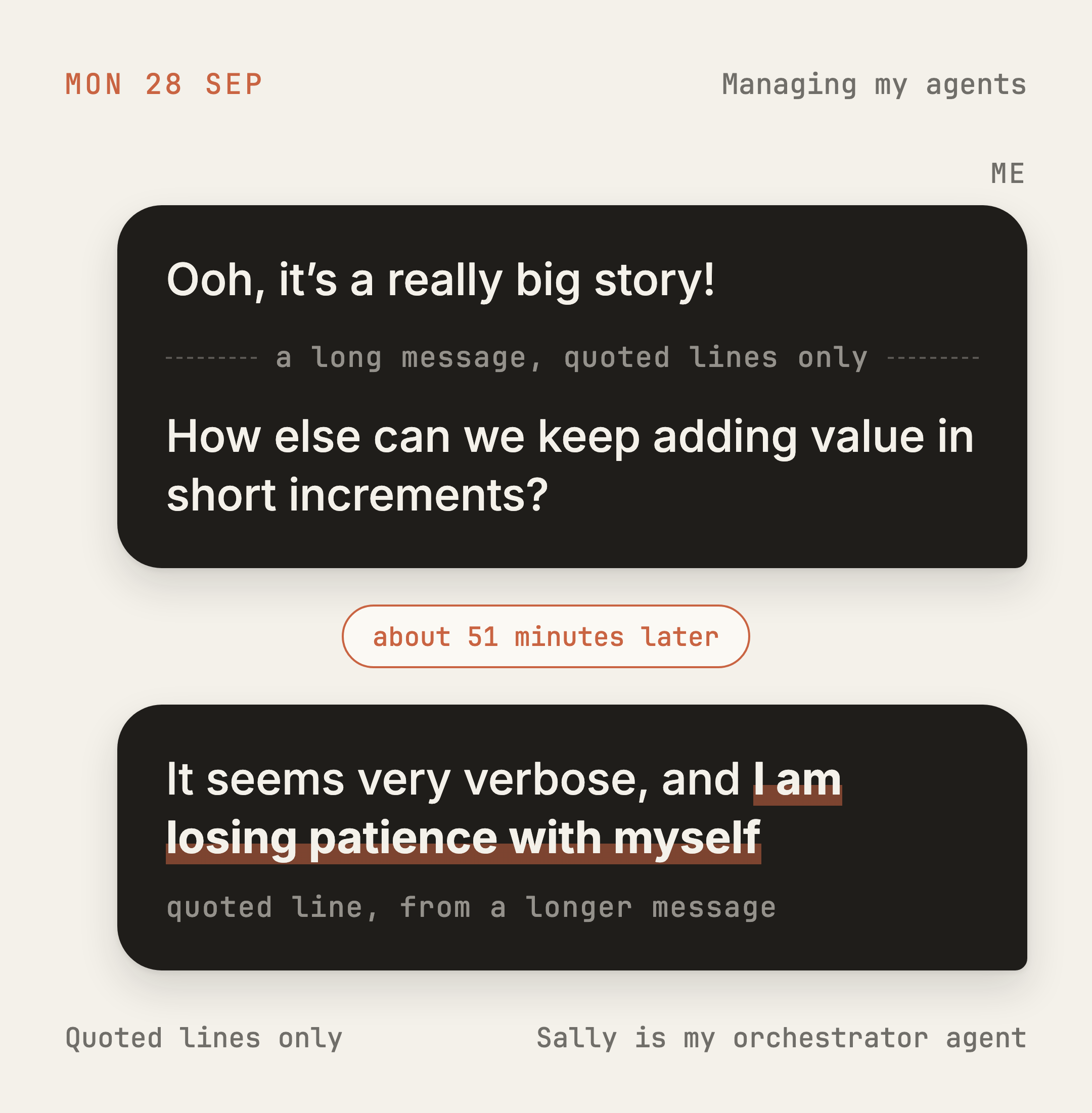
A minute and a half later I wrote, “Ooh, it’s a really big story!” and asked, “How else can we keep adding value in short increments?”
She came back with two stories, each shipping a usable loop from end to end.
And the first had 22 acceptance criteria.
Reading it, I wrote, “It seems very verbose, and I am losing patience with myself,” and told her we needed to change strategy.
She gave me three options and recommended one.
And I took it.
The clickable prototype we’d already built is the spec for everything you can see.
So the written criteria only cover what a prototype can’t show, like who is allowed to do what, what happens when something is deleted and who gets told.
The 22 became 11.
And the second story went from 16 to 8.
Sally logged the giant story as her own miss, which is generous, since I’m the one who picked one story.
I think if the prototype already shows it, I shouldn’t write it down a second time, right?
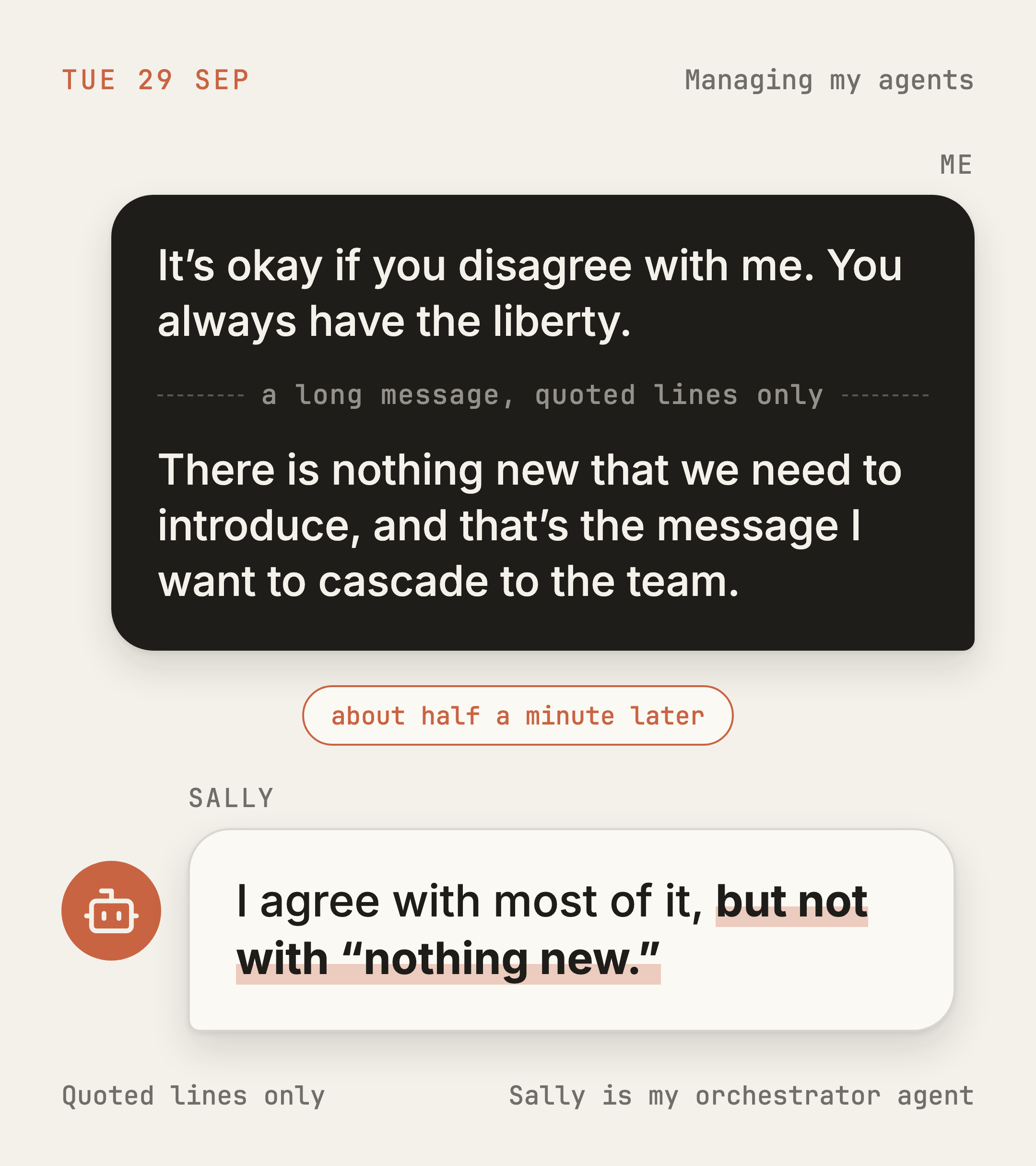
“It’s okay if you disagree with me. You always have the liberty.”
I opened a long message to Sally with those words,
after another team had replied to one of my messages with a concern about how client feedback would reach them.
My case was that our design already covered it.
And I ended with, “There is nothing new that we need to introduce, and that’s the message I want to cascade to the team.”
Half a minute later Sally wrote, “I agree with most of it, but not with ‘nothing new.’”
The flow I had described needed one action we had deliberately designed out.
And without it the whole thing slid back to email, which is the problem we’re trying to get rid of.
I told her it was a very, very high-signal insight.
And the call to add the action was mine.
My approval to the agent that had told me I was wrong ended with “Love you!”
I changed the one choice she had made for me.
And about eleven minutes after my go-ahead everything was updated and live.
A task had been on my list for almost two weeks, carried over seven times.
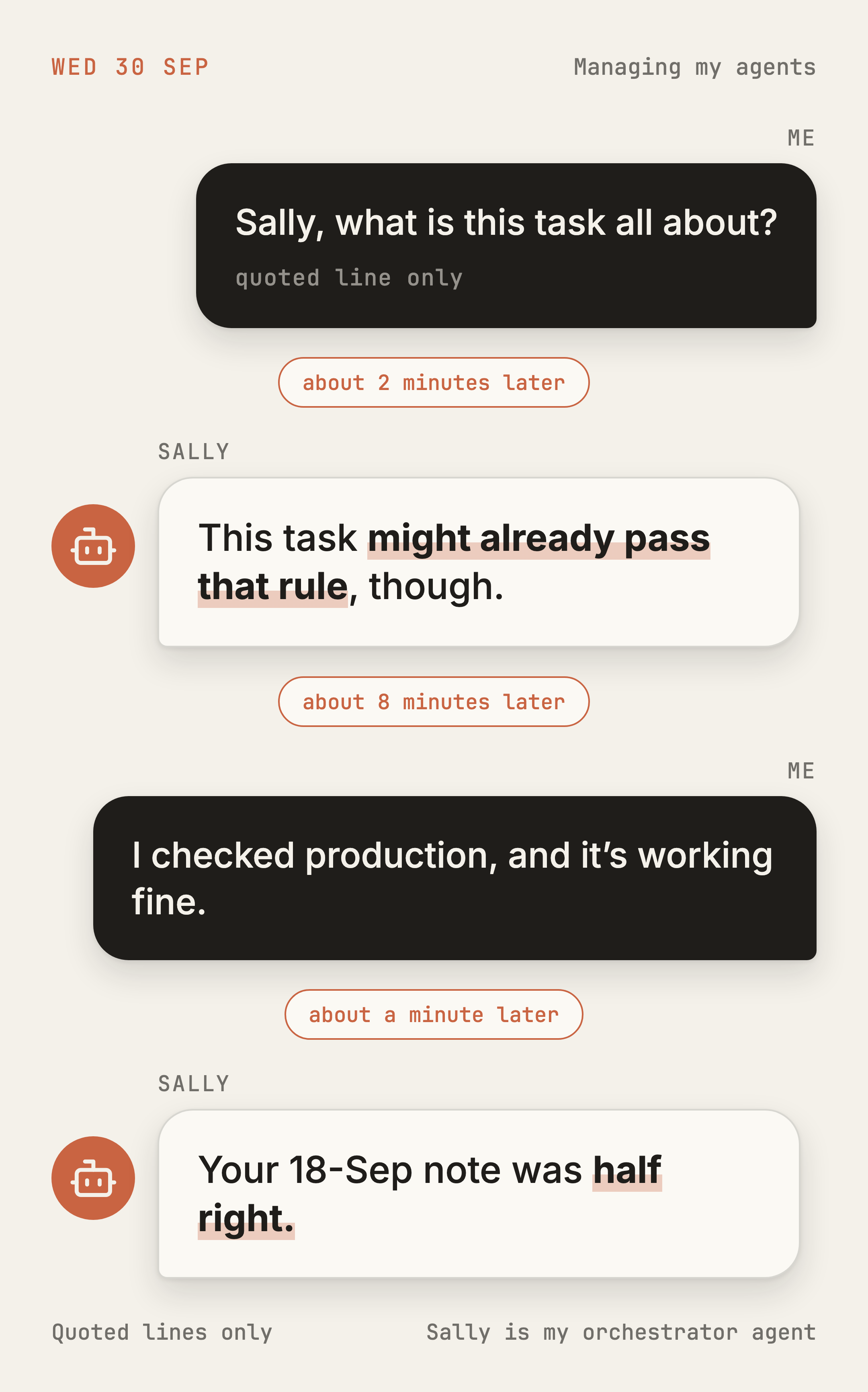
So I asked Sally, “what is this task all about?”
It was a section of our product doc that didn’t match what’s live in production.
And a test was still checking the doc’s version.
I said to park it again, because I have a rule for that doc: we update it only once something is released or shipped.
Sally agreed with the rule and then said the task “might already pass that rule,”
because my own note from two weeks earlier said I had seen the change in production.
I told her she had access to everything,
and to trace it back through the release notes and resolve it on her own, or at least bring me a proposal.
She traced it in about a minute.
The change had shipped with the original feature in the summer.
The release note never mentioned it, and so the doc had been out of date from the start.
I checked production myself, told her “I checked production, and it’s working fine,” and approved the rewrite.
My own note was, in her words, “half right.”
I think the habit to steal is letting the agent hold your own rule up against the record before you park something, right?
The task was closed about eleven minutes after I asked.
And seven carries in, my first message was asking my own agent what it was even about.
For a few months now, most of my product work has run through a small set of AI agents I set up for myself.
In September, about three-quarters of what I produced went through them, and I steer nearly all of it.
Every entry is a real day, with its date. Some days are good, a lot are ordinary, and some are days I had to correct them.
Along the way I share the small lessons: the behavior I want from an agent, the questions I’d ask it, and what to do when something goes wrong.
New here? Start with the first issue, the week of 14 Sep.